
Dentures in Turkey
Full, partial and snap-on dentures explained: how they are made in Turkey, what they cost per arch and what getting used to them takes.
- Typical package price in Turkey (2026)
- €400 – €1,200
- Time in Turkey
- 5–10 days; implants: 2 trips
Indicative range from published package prices; your written quote depends on your case. · Updated:
Full specialty guide
At a glance
- Typical package price in Turkey (2026)
- €400 – €1,200
- Procedure time
- 4–5 fitting visits
- Anaesthesia
- None; local for extractions/implants
- Hospital stay
- None (outpatient)
- Time in Turkey
- 5–10 days; implants: 2 trips
- Recovery
- Same day; a few weeks to adapt
- Final result
- At fitting; comfortable in a few weeks
Dentures are removable replacement teeth. A complete (full) denture replaces every tooth in the upper or lower jaw, and a partial denture fills gaps between remaining teeth. A denture can also clip onto two to four implants as an implant-retained overdenture (a snap-on denture), far steadier than a conventional lower denture. In Turkey in 2026 a conventional full denture typically costs about €400–€1,200 per arch, and a snap-on denture roughly €2,000–€6,000 per arch including implants. Conventional dentures take 5–10 days of fitting visits; implant options usually need two trips.
What dentures are and how they work
A denture is a gum-coloured acrylic base carrying artificial teeth, sometimes with a metal framework. An upper full denture is held mainly by suction against the palate and usually feels secure. A lower one has far less to grip, as the tongue moves it and the ridge is narrower, so it is often looser. Partial dentures clip to neighbouring teeth. After teeth are lost the jawbone slowly shrinks, so dentures loosen over time and need relining or remaking. Implants change this: attachments lock the denture in place, and an overdenture also helps preserve the bone beneath it.
Types of dentures compared
| Type | How it stays in | Suitable for | Main trade-off |
|---|---|---|---|
| Complete acrylic denture | Suction and muscle control | All teeth missing; non-surgical option | Lower dentures often loose; upper covers the palate |
| Immediate denture | Fitted the day teeth are removed | Never being without teeth | Needs relining or replacing as gums heal |
| Partial acrylic denture | Wire clasps on remaining teeth | Several gaps; budget or interim option | Bulkier; clasps may show |
| Cast-metal (chrome-cobalt) partial | Metal clasps on natural teeth | Long-term use with strong remaining teeth | Costs more; metal may show |
| Flexible (nylon) partial | Gum-coloured flexible clasps | Comfort and appearance | Hard to adjust or add teeth to |
| Snap-on overdenture | Clips onto 2–4 implants; removable | Loose lower dentures; moderate budget | Surgery needed; attachment parts wear |
| Fixed bridge (All-on-4/All-on-6) | Screwed onto 4–6 implants | Wanting non-removable teeth | Highest cost; harder to clean |
The right option depends on your bone, remaining teeth, health and budget.
Snap-on dentures or fixed All-on-4?
A snap-on overdenture is removable for cleaning, and its acrylic flange can support the lips where bone has shrunk. It needs fewer implants and costs less than a fixed bridge. All-on-4 and All-on-6 bridges are screwed in and feel closer to natural teeth, but cost more and need careful cleaning. In the lower jaw two implants are often enough; the softer upper jaw usually needs more. A 2021 systematic review of randomised trials found two-implant lower overdentures gave better satisfaction, comfort, speech and stability than conventional dentures, though satisfaction with hygiene was lower.
Who is a good candidate
- People missing all their teeth in one or both jaws who want an affordable, non-surgical option
- People missing several teeth whose remaining teeth can support a partial denture
- Those who cannot have dental implants for medical reasons, lack of bone or cost; thin bone may first need a bone graft or sinus lift
- Wearers of a loose lower denture: two implants with snap-on attachments can make a big difference
- Less suitable: a strong gag reflex or very dry mouth can make conventional dentures hard to tolerate; implant options may help
- Not a reason to extract healthy teeth: a plan that removes restorable teeth just to fit a denture or implant bridge deserves a second opinion
The process step by step
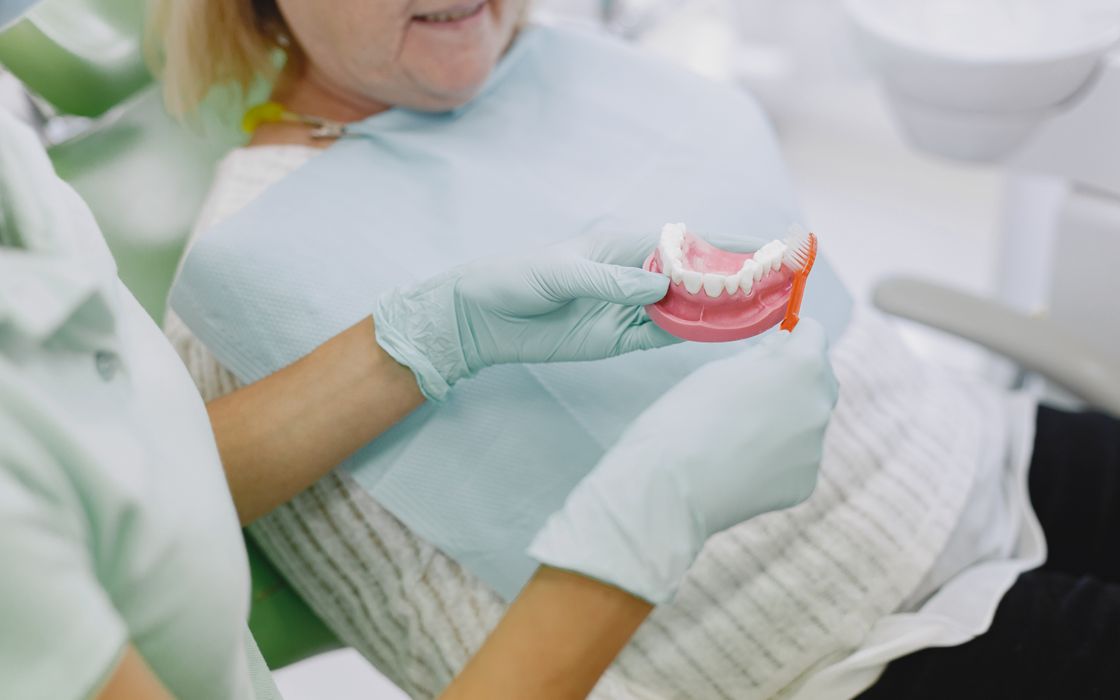
Assessment and planning
The dentist examines your mouth, takes X-rays (a 3D scan if implants are planned) and agrees the denture type, shade and tooth shape with you.
Extractions and immediate denture
Teeth that cannot be saved are removed under local anaesthetic, and an immediate denture can be fitted the same day.
Impressions and bite record
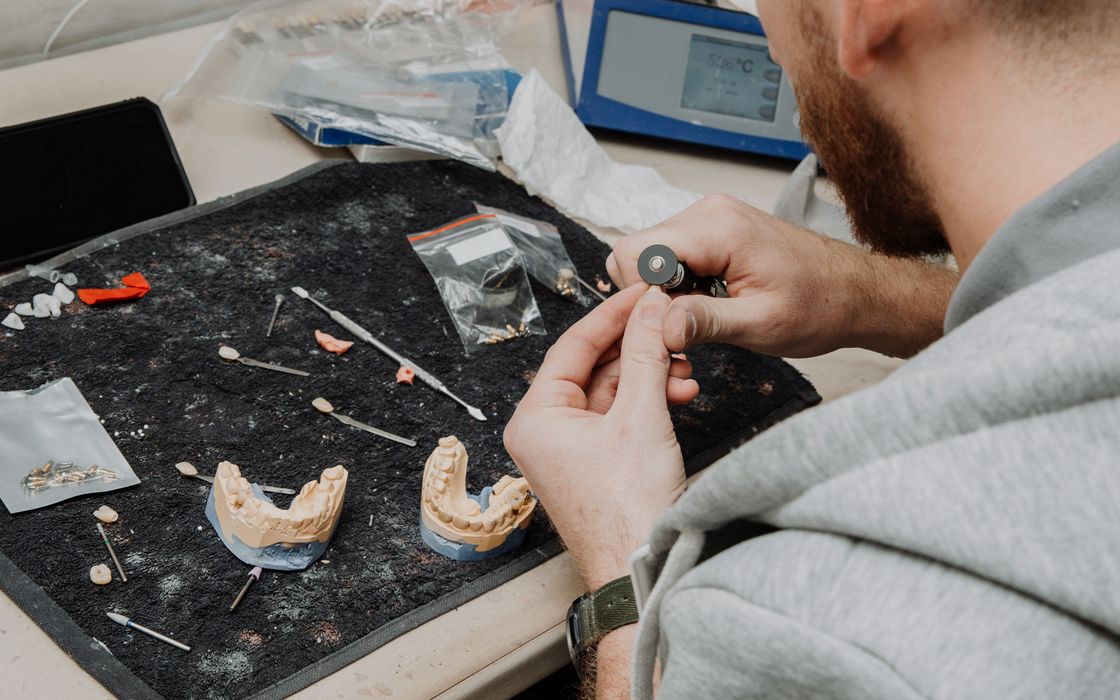
Moulds or digital scans are taken, then a record of how your jaws meet, to guide the technician.
Try-in
You try the teeth set in wax to check appearance, bite and speech; changes are easy at this stage.
Fitting and adjustments
The denture is fitted, sore spots are eased and you learn to insert, remove and clean it. Expect a review a few days later.
For snap-on dentures
Two to four implants usually heal for a few months before the attachments are connected and the denture is fitted, typically on a second trip.
Recovery and adaptation timeline
Days 1–3
First days
After extractions expect soreness and some swelling. Follow the clinic's advice on wearing the denture and eat soft food cut small.
Weeks 1–2
Sore spots and speech
Pressure spots are common and easily adjusted. Extra saliva usually settles, and reading aloud helps your speech.
Weeks 2–6
Learning to eat
Most people return to a normal diet once used to their dentures; a lower full denture takes longest.
Months 3–12
Gums settle
As gums and bone shrink after extractions, immediate dentures often need relining or replacing within the first year.
Every 5–8 years
Replacement
Dentures wear and the jaw keeps changing; regular check-ups catch a loose fit early.
Results and how long they last
A well-made denture restores your smile and makes speaking and chewing easier, but it never feels quite like natural teeth, especially a lower full denture. The Oral Health Foundation says dentures often need replacing every five to eight years to keep fitting well. In between, a reline reshapes the fitting surface to your changed gums; on snap-on dentures the small retention inserts wear out and are swapped periodically. The 2002 McGill consensus statement named a two-implant overdenture the first-choice treatment for a toothless lower jaw.
Risks and how to reduce them
- Sore spots and ulcers from pressure points: common early on and fixed with adjustments; have any ulcer that does not heal checked
- Loosening over time as the jawbone shrinks: managed with relines, a new denture or implants
- Denture stomatitis, a fungal infection under the denture: reduced by daily cleaning and taking it out at night unless your dentist advises otherwise
- Decay and gum disease around teeth holding a partial denture, because clasps trap plaque: clean teeth and denture carefully
- Breakage: dentures can crack if dropped, so clean them over a towel or a bowl of water
- Implant complications with snap-on dentures: infection, inflammation around implants or, rarely, implant failure or nerve injury; planning and check-ups reduce the risk
Adjustments continue after you fly home
New dentures almost always need small adjustments, and immediate dentures need relining as the gums heal, often months after your trip. Plan this with a dentist at home, ask for your records and, for implants, get the implant brand and attachment type in writing so parts can be sourced later. Never agree to remove healthy teeth because a package is built around it.
Cost of dentures in Turkey and what's included
€400–€1,200
Typical price per arch (conventional full denture)
None
Hospital stay: outpatient treatment
5–10 days
Time in Turkey (implant options usually need two trips)
| Option | Guide price in Turkey |
|---|---|
| Conventional full acrylic denture | €400–€1,200 per arch |
| Immediate (temporary) acrylic denture | From about €300 per arch |
| Partial denture (acrylic, flexible or cast metal) | From about €300, by type and size |
| Snap-on overdenture on 2–4 implants | €2,000–€6,000 per arch |
| Fixed All-on-4 bridge, for comparison | €3,500–€7,000 per arch |
Guide prices for 2026. Extractions, bone grafts, 3D scans, relines, travel and accommodation are often extra.
Inclusions vary: some quotes cover extractions, a temporary denture and every fitting visit, others only the final denture. Implant prices depend on the brand, the number of implants and the attachment system. Treat these figures as a guide, not a quote, and ask for a written plan listing every appointment and material. You can get free quotes from several clinics to compare them.
Choosing a clinic safely
- A Ministry of Health-licensed clinic or hospital (some also hold international accreditation such as JCI) with the ministry's health-tourism authorisation certificate (Uluslararası Sağlık Turizmi Yetki Belgesi)
- Treatment led by a prosthodontist (Protetik Diş Tedavisi uzmanı) or an experienced dentist registered with the Turkish Dental Association, with an oral surgeon for implants
- A proper sequence of impressions, bite record, try-in and fitting, not a finished denture promised in a day
- A written quote naming the materials, implant and attachment brand, included adjustments and relines, and the policy if the denture breaks or does not fit
- Genuine before-and-after photos and honesty about the limits of lower full dentures
- Red flags: pressure to extract savable teeth, prices far below the market with vague inclusions, and no aftercare plan once you are home
Bring your old denture and photos
If you already wear a denture, bring it: it shows what works and what does not. Old photos of your natural smile help the technician choose the shape and size of your new teeth.
The right denture is the one you can live with every day, which is why the try-in, the adjustments and the aftercare matter as much as the price.
— WhichClinic Editorial Team
Clinics offering Dentures in Istanbul
Stars are Google ratings (third-party data), not WhichClinic reviews. Listings are compiled from public business data. Confirm that the clinic performs this procedure when you request a quote.
- 15.0 (1,451)
Beyoğlu, Istanbul
- 25.0 (1,039)
Fatih, Istanbul
- 3 5.0 (792)
- 45.0 (506)
Ataşehir, Istanbul
- 55.0 (401)
Beşiktaş, Istanbul
- 65.0 (356)
Pendik, Istanbul
- 75.0 (336)
Üsküdar, Istanbul
- 85.0 (205)
Eyüpsultan, Istanbul
Get free quotes for Dentures (Full & Partial, incl. Implant-Supported)
Tell us what you need and receive tailored offers from matched clinics — free, private and with no obligation.
- Verified badge only after document checks
- Free and no obligation
- Compare multiple offers side by side
Your details stay private — shared only with matched clinics.
Frequently asked questions
Usually a few weeks. Speech tends to adapt first; eating takes longer, especially with a lower full denture. Start with soft food cut into small pieces and chew on both sides. Sore spots are normal early on and are fixed with small adjustments, so do not put up with pain.
Conventional full or partial dentures can usually be made in about 5–10 days over several short visits. If teeth are extracted, an immediate denture is fitted, but it will need relining or replacing as the gums heal, usually back home within the first year. Snap-on dentures on implants normally need two trips a few months apart.
In 2026 a conventional full denture typically costs about €400–€1,200 per arch, and a snap-on overdenture on 2–4 implants about €2,000–€6,000 per arch. Partial dentures start at around €300. These are guide prices; the final cost depends on materials, extractions and implants, so ask for a written quote.
Neither is better for everyone. Snap-on dentures cost less, need fewer implants, are easy to clean and can support sunken lips. All-on-4 teeth are fixed and feel closer to natural teeth, but cost more and need careful cleaning around the implants. Your bone, budget and preferences decide.
The Oral Health Foundation says dentures often need replacing every five to eight years to keep fitting well. In between, relines restore the fit as your gums change, and on snap-on dentures the small retention inserts are replaced when they wear.
Generally no. The NHS advises not wearing dentures overnight unless your dentist recommends it. Taking them out gives your gums a rest and lowers the risk of infection; clean them and keep them in a little water so they do not dry out and warp.
A reline or a new denture can improve the fit, but a lower full denture often stays mobile because there is little to grip. Two implants with snap-on attachments are a common, well-studied way to stabilise it, and they cost less than fixed implant teeth.
Small adjustments are normal in the first weeks and relines follow later, so arrange a local dentist before you travel. Ask the clinic for your records and, for implants, the implant and attachment details, and check in writing what the clinic covers if the denture breaks or does not fit.
Sources
Medical background was checked against these references. This guide is educational and does not replace a consultation with a qualified doctor.
- NHS — Dentures (false teeth)
- Oral Health Foundation — Dentures
- American Dental Association (MouthHealthy) — Dentures
- American College of Prosthodontists — Dentures
- Systematic review and meta-analysis (2021) — Quality of life and satisfaction with complete dentures versus mandibular implant overdentures
- General Dental Council (UK) — Going abroad for dental treatment