
Composite Bonding in Turkey
Tooth-coloured resin sculpted onto your teeth to fix chips, gaps and uneven edges — usually with little or no drilling.
- Typical package price in Turkey (2026)
- €100 – €250
- Time in Turkey
- 2–4 days
Indicative range from published package prices; your written quote depends on your case. · Updated:
Full specialty guide
At a glance
- Typical package price in Turkey (2026)
- €100 – €250
- Procedure time
- 30–60 minutes per tooth
- Anaesthesia
- Usually none; local if needed
- Hospital stay
- None — outpatient
- Time in Turkey
- 2–4 days
- Recovery
- Same day — no downtime
- Final result
- Immediately after treatment
Composite bonding is a conservative cosmetic treatment in which a dentist sculpts tooth-coloured resin onto your teeth to repair chips, close small gaps and even out worn edges. Because material is added rather than enamel filed away, it is often the gentlest way to improve a smile. In Turkey it typically costs €100–€250 per tooth, and several teeth can usually be done in a 2–4-day trip.
What composite bonding is and how it works
Composite is a resin filled with fine glass or ceramic particles, available in many tooth shades. The dentist cleans the tooth, lightly roughens it with a mild acid gel, paints on a bonding agent and builds the composite up in thin layers, hardening each with a curing light, then shapes and polishes it. Most bonded teeth need no drilling and no injection, and each takes roughly 30–60 minutes.
Edge bonding vs full composite veneers
Edge bonding adds resin only where it is needed — a chipped corner, a short or worn edge, a small gap. A composite veneer covers the whole visible front of the tooth to change its colour or shape more noticeably. Both are made directly in the chair in one visit, unlike porcelain veneers, which are made in a laboratory and usually need some enamel to be removed.
Composite bonding compared with other options
| Option | Tooth preparation | Typical lifespan | Repairs and staining |
|---|---|---|---|
| Edge bonding | None or minimal | Several years; touch-ups common | Easy to repolish or add to; margins can stain |
| Full composite veneer | None or minimal | Around 3–10 years | Repairable in the chair; stains more than porcelain |
| Porcelain veneer | Usually some enamel removed | Longer than composite | Resists staining; a chip usually means replacement |
| Crown | Tooth reduced on all sides | Long-lasting | Irreversible; best for broken or heavily filled teeth |
Lifespans vary with bite, habits and hygiene; composite figures from Cleveland Clinic.
Who is a good candidate
- People with healthy teeth and gums who want to fix small chips, minor gaps, short or uneven edges or slightly irregular shapes
- Anyone who wants to keep their natural enamel and avoid drilling for a cosmetic change
- Patients who accept that composite needs polishing and occasional repairs
- Less suitable if you grind or clench heavily, have a deep bite, untreated decay or gum disease, or very dark staining — these need a proper assessment first
- For crooked or crowded teeth, orthodontics is often the better first step; bonding can fine-tune the shape afterwards
The procedure step by step
Assessment and planning
Send photos and recent X-rays in advance. The dentist checks for decay, gum health and your bite, and agrees which teeth to treat — ideally with a mock-up of the planned shape.
Whitening first, if you want it
Composite does not lighten with bleaching, so teeth whitening comes first and the resin is matched to the new shade. Many dentists prefer a short gap between the two, so ask how your clinic plans this.
Shade matching and preparation
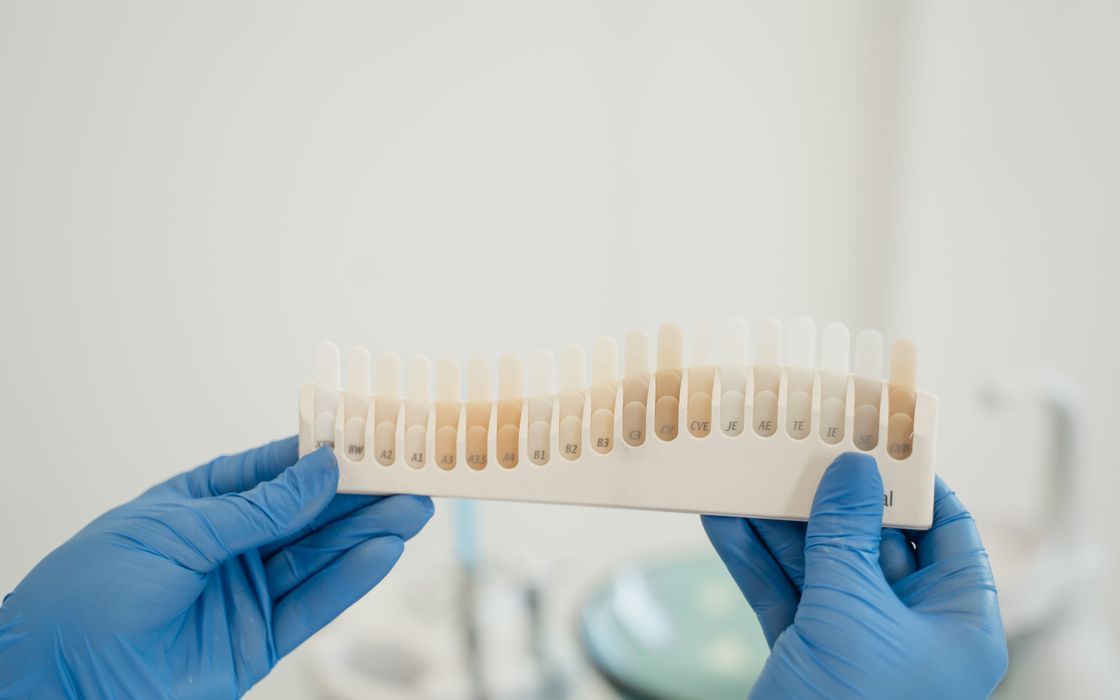
The dentist picks shades with a shade guide, cleans and lightly etches the teeth and applies a bonding agent. An anaesthetic is usually only needed if a tooth has decay or must be reshaped.
Layering, curing and shaping
Resin is added in thin layers, each hardened with a curing light, then sculpted and polished — roughly 30–60 minutes per tooth, so a full smile can take most of a day.
Bite check and review
The dentist checks how your teeth meet and smooths any high spots. A short review a day or two later, before you fly home, allows rough or bulky areas to be adjusted.
Recovery timeline
Same day
Back to normal
There is no real recovery period. Teeth may feel slightly different, and many dentists advise going easy on coffee, tea and red wine for a day or two.
Days 1–3
Check and fine-tune
Mild sensitivity or a feeling of bulk usually settles quickly. Mention sharp edges or a high bite at your review so they can be adjusted.
First weeks
Getting used to the new edges
Don't bite nails, pens or very hard foods with your front teeth, or open packets with them — composite edges can chip.
Every 6–12 months
Check-ups and polishing
Regular hygiene visits and a gentle polish help composite keep its shine; a clinical study found yearly fine polishing helped maintain composite veneers.
After several years
Repair or replace
Bonding typically lasts about 3–10 years before it needs touching up or replacing. Chips and worn areas can usually be repaired by adding resin rather than starting again.
Results and how long they last
Results are visible immediately. Good bonding blends in with natural teeth, but composite is not as hard or stain-resistant as porcelain: over time it can pick up stains, lose its polish and chip, especially at the biting edge. Cleveland Clinic puts its typical lifespan at 3–10 years, and a six-year study of composite veneers found that regular fine polishing was needed to keep them looking their best. Most problems can be fixed in one visit by repolishing or adding resin, and because little or no enamel was removed, your options stay open — including porcelain veneers later.
Risks and how to reduce them
- Chipping or fracture, especially on biting edges and in people who grind — a night guard can help
- Staining and loss of shine from coffee, tea, red wine and smoking, usually starting at the margins
- Debonding, when part of the resin comes away — usually quick to re-bond
- Temporary sensitivity, which normally settles within days
- Bulky or unnatural-looking teeth from over-contouring, which can also trap plaque at the gumline — ask for a mock-up first
- Decay at the edges of the resin if cleaning is poor — brush, floss and keep regular check-ups
The “Turkey teeth” lesson: keep your enamel
“Turkey teeth” is a UK media label for smiles made from full sets of crowns, often sold as “veneers”. A 2025 British Dental Journal review of UK news reports found many patients did not realise they were getting crowns, which need much more aggressive tooth reduction, and some described irreversible harm. Over-treatment is not unique to Turkey, and many Turkish dentists work conservatively — but if a clinic proposes filing down healthy teeth for a cosmetic change, ask whether bonding, whitening or orthodontics could do the job first.
Cost of composite bonding in Turkey and what's included

€100–€250
Typical price per tooth
None
Hospital stay — done in the dental chair
2–4 days
Typical time in Turkey
| Item | Typical 2026 price or status |
|---|---|
| Composite bonding, per tooth | €100–€250 |
| Example: 4 front teeth | €400–€1,000 |
| Example: 8 upper teeth (a typical smile case) | €800–€2,000 |
| Consultation, photos and X-rays | Often included — confirm in writing |
| Whitening before bonding | Usually charged separately |
| Hotel and airport transfers | Included in some packages |
| Flights, later repairs and repolishing at home | Not included |
Guide ranges from published Turkish price lists (2026); your written quote is what counts.
Prices vary with the clinic, the dentist's experience, the composite brand and how much resin each tooth needs; most price lists quote one per-tooth fee for both small edge repairs and full composite veneers. Bonding usually costs far less than porcelain veneers or a Hollywood smile, but the cheapest offer is not always the best value. Ask for a written, itemised quote listing the teeth, materials and what happens if a bond chips once you are home — and get free quotes from several clinics to compare.
Choosing a clinic safely
- A clinic licensed by the Turkish Ministry of Health that also holds the ministry's health-tourism authorisation for international patients (Uluslararası Sağlık Turizmi Yetki Belgesi)
- A named dentist experienced in cosmetic bonding — ideally a restorative dentistry or prosthodontics specialist — registered with the local dental chamber of the Turkish Dental Association (TDB)
- A written quote listing each tooth, the materials, what is included and the policy for chips or debonding after you return home
- Before-and-after photos of bonding cases, not crowns — and be wary of identical, very white “piano-key” smiles
- Red flags: pressure to crown or file down healthy teeth, no examination or X-rays, and “new smile in a day” offers that don't explain what will be done
- Talk to your own dentist before you travel and agree how check-ups and repairs will be handled at home
Ask this before any drilling
Ask directly: “Can this be done with no-prep or minimal-prep bonding?” and request a mock-up to see the planned shape on your own teeth before anything irreversible happens. Crowns still have a place for broken or heavily filled teeth — see dental crowns.
In cosmetic dentistry, the treatment that removes the least tooth is often the one you'll be happiest with in ten years. If a chip or gap can be fixed by adding resin, think twice before having healthy enamel filed away.
— WhichClinic Editorial Team
Clinics offering Composite Bonding in Istanbul
Stars are Google ratings (third-party data), not WhichClinic reviews. Listings are compiled from public business data. Confirm that the clinic performs this procedure when you request a quote.
- 15.0 (4,201)
Zeytinburnu, Istanbul
- 25.0 (3,423)
Başakşehir, Istanbul
- 35.0 (1,451)
Beyoğlu, Istanbul
- 45.0 (1,174)
Şişli, Istanbul
- 55.0 (1,125)
Bahçelievler, Istanbul
- 65.0 (1,040)
Üsküdar, Istanbul
- 75.0 (1,039)
Fatih, Istanbul
- 8 5.0 (792)
Get free quotes for Composite Bonding (Composite Veneers / Edge Bonding)
Tell us what you need and receive tailored offers from matched clinics — free, private and with no obligation.
- Verified badge only after document checks
- Free and no obligation
- Compare multiple offers side by side
Your details stay private — shared only with matched clinics.
Frequently asked questions
Typically about 3–10 years before it needs touching up or replacing, according to Cleveland Clinic. How long yours lasts depends on your bite, habits such as nail-biting or grinding, what you eat and drink, and how well it is maintained. Chips and dull areas can usually be repaired by adding resin and repolishing.
Bonding is one of the most tooth-friendly cosmetic options because it usually needs little or no enamel removal — the surface is only lightly etched so the resin can grip. That is why it is often suggested before veneers or crowns. It can usually be polished off or redone later, although a treated tooth is never completely untouched.
Neither is better for everyone. Bonding is cheaper, quicker, usually drill-free and easy to repair, but it stains and chips more readily and needs more maintenance. Porcelain veneers last longer and resist staining, but usually need some enamel removed and cost more. For small chips, gaps and edges, bonding is often the sensible first choice.
Usually not. Because most bonding involves no drilling, an anaesthetic is rarely needed. Some people notice mild sensitivity for a few days afterwards. If a tooth has decay or needs reshaping, the dentist will numb it first.
No — whitening only lightens natural teeth, not composite. If you want whiter teeth, whiten first and have the bonding matched to the new shade. Whitening afterwards can leave bonded teeth looking darker than their neighbours, which then means replacing the resin.
Most published Turkish price lists for 2026 fall roughly between €100 and €250 per tooth, so eight upper teeth might cost about €800–€2,000. The price depends on the clinic, the dentist and the materials, and on whether a hotel and transfers are included. Always get a written quote.
Usually 2–4 days: an examination and planning visit, the bonding appointment (about 30–60 minutes per tooth) and a short review before you fly. If you want whitening first, allow extra time and ask how the clinic schedules the two.
Small gaps, yes — resin can be added to the sides of the teeth to close them. Large gaps, or gaps caused by crowding or bite problems, are often better treated with orthodontics first, because widening teeth too much with resin can look unnatural.
Sources
Medical background was checked against these references. This guide is educational and does not replace a consultation with a qualified doctor.
- Cleveland Clinic — Dental bonding
- American Dental Association (MouthHealthy) — Veneers
- NHS — Teeth whitening
- Oral Health Foundation — Going abroad for dental treatment
- British Dental Journal (PMC) — Contemporary dental tourism: a review of reporting in the UK news media
- Clinical Oral Investigations (PMC) — 6-year clinical performance of resin composite veneers