
DHI Hair Transplant in Turkey
DHI hair transplant in Turkey: Choi-pen precision, minimal or no shaving, and an honest look at density and cost.
- Typical package price in Turkey (2026)
- €2,000 – €4,000
- Time in Turkey
- 2–3 days
Indicative range from published package prices; your written quote depends on your case. · Updated:
Full specialty guide
At a glance
- Typical package price in Turkey (2026)
- €2,000 – €4,000
- Procedure time
- 6–8 hours or longer
- Anaesthesia
- Local anaesthetic, optional sedation
- Hospital stay
- None — day procedure
- Time in Turkey
- 2–3 days
- Recovery
- Back to normal life in about 7–10 days
- Final result
- Around 12 months
DHI has become one of the most requested hair transplant techniques in Turkey — often marketed as the premium, 'no-shave' option. It shares the same foundation as FUE (individual follicles from your own donor area) but changes how grafts are implanted, using a specialised pen. For the right candidate that can mean tighter placement and less time out of the socket, but it is slower and usually costs more — so it is worth understanding exactly what you are paying for.
What is DHI and how does the Choi pen work?
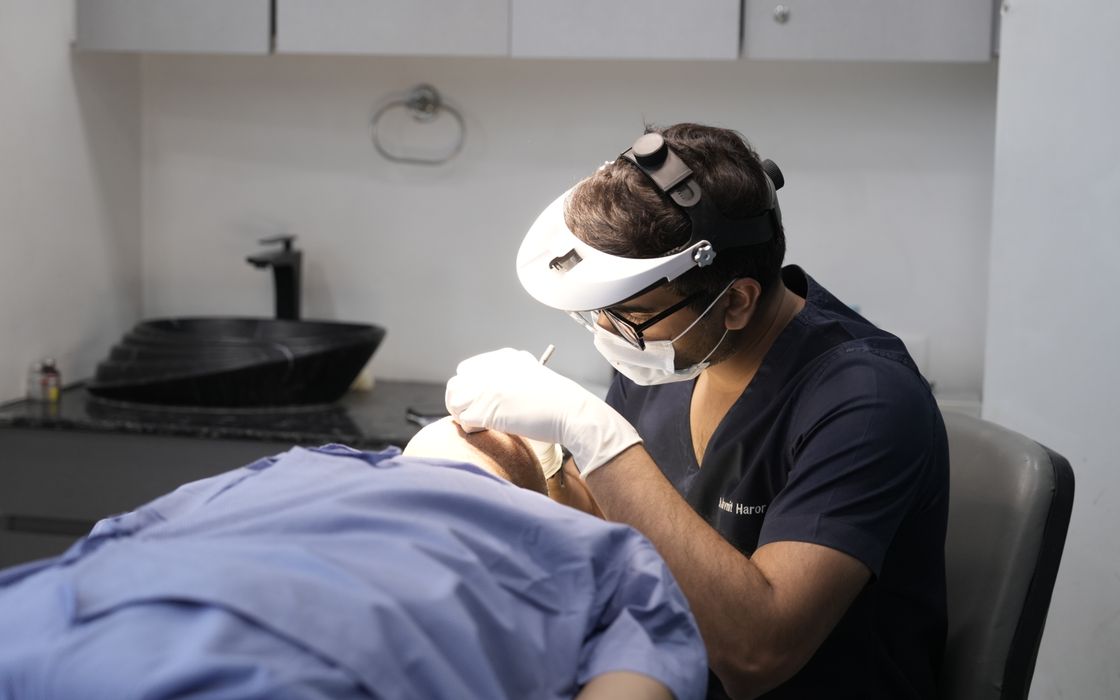
DHI (Direct Hair Implantation) uses a Choi implanter pen — a hollow needle that holds a single follicular unit. Instead of the surgeon first cutting channels and then placing grafts (as in FUE), the pen creates the incision and delivers the graft in one motion. Because there is no separate canal-opening step, grafts spend less time outside the body and the surgeon controls the exact angle, depth and direction as each hair goes in. This is what allows dense, natural placement and, in many cases, implanting into areas without shaving them first.
DHI vs FUE and Sapphire FUE
| Feature | DHI (Choi pen) | FUE / Sapphire FUE |
|---|---|---|
| Channel opening | Combined with implantation; no pre-cut channels | Separate step, then grafts placed |
| Shaving | Often minimal or no-shave possible | Donor usually shaved |
| Density control | Very precise, good for hairlines | High, especially with sapphire blades |
| Time & grafts/session | Slower, often fewer grafts | Faster, larger sessions feasible |
| Typical cost | Higher | Lower to mid |
Neither is universally 'better' — the right choice depends on your case, not the marketing label.
Who is DHI best suited to?
- People who want a no-shave or minimal-shave result, for example to return to work quickly or keep the procedure discreet
- Women and those adding density to thinning areas without shaving the surrounding hair
- Hairline and frontal work where precise angle and direction matter most
- Smaller to medium sessions rather than very large areas of baldness in a single sitting
- Patients who accept a higher price and longer procedure in exchange for that control
The DHI procedure step by step

Planning & hairline design
The surgeon maps the hairline and agrees graft numbers. For no-shave cases, hair length and donor plan are discussed in advance.
Anaesthesia
Local anaesthetic numbs the donor and recipient areas; the procedure is awake and comfortable once numb.
Extraction
Follicular units are harvested individually, as in FUE, and loaded one at a time into Choi pens.
Direct implantation
The pen incises and implants each graft in a single motion, letting the surgeon set exact angle, depth and density as they go.
Immediate aftercare
There are no pre-cut channels to heal beforehand; the team explains washing, sleeping position and protecting the grafts.
Recovery — what to expect
Days 1–3
Redness, little swelling
DHI often causes less swelling than channel-based methods. Tiny scabs form around each implant and the first wash is usually on day 2–3.
Days 7–10
Back to normal
Scabs clear and the recipient area calms down. No-shave patients often find it easy to blend back into daily life.
Weeks 2–4
Shock loss
The implanted hairs shed — expected shock loss, not a lost graft. The roots stay in place.
Months 3–6
Regrowth
New hairs emerge and slowly thicken; the frontal design starts to take shape.
Months 9–12
Full result
Density matures and the hairline looks natural. Judge the final outcome at around 12 months.
Results and permanence — honestly
DHI does not create denser hair than physics allows — it gives the surgeon more control over placement, which can produce a very natural hairline in skilled hands. The transplanted follicles are permanent because they come from DHT-resistant donor hair, but DHI still moves a limited supply and cannot restore a full teenage head of hair. In one careful session most patients achieve a natural improvement; larger areas may need a second session. Be wary of clinics that promise 'higher survival rates' as a hard number — DHI can be gentle on grafts, but outcomes still depend on the surgeon's skill and your own biology.
Cost in Turkey and what's included
| Package element | Typically included? |
|---|---|
| Surgeon consultation & hairline design | Yes |
| DHI procedure with Choi pens | Yes |
| No-shave option (where suitable) | Sometimes at a premium |
| Medications, aftercare kit & first wash | Usually |
| Hotel & transfers; flights & long-term follow-up | Hotel/transfers often; flights rarely |
DHI usually costs more than standard FUE for the same graft count — confirm exactly what the higher price buys.
€2,000
Typical starting price
2,000–4,000
Grafts per session
12 months
To judge the full result
Choosing a clinic safely
- Confirm the surgeon performs or closely supervises the implantation, not just technicians with pens
- Ask whether true no-shave is realistic for your case — it is not suitable for everyone or every graft count
- Check that the higher DHI price reflects real added value, not just a marketing upgrade
- Request genuine before-and-after cases done with DHI at a similar stage to yours
- Get the graft number and what is included in writing before you commit
'No-shave' has limits
No-shave DHI is genuinely useful, but it is harder, slower and not appropriate for large sessions or very tight donor areas. If a clinic promises full no-shave coverage for a very high graft count at a bargain price, be cautious — pushing volume through Choi pens without proper skill can damage grafts and waste your donor.
Medical disclaimer
This guide is general information, not medical advice. Whether DHI, FUE or another approach suits you depends on your individual hair loss, donor quality and goals. Always obtain a personalised assessment from a qualified surgeon before deciding.
DHI's advantage is control, not magic. In the right hands it builds a natural hairline graft by graft — but it still works within the limits of your own donor hair.
— WhichClinic Editorial Team
Clinics offering DHI Hair Transplant in Istanbul
Stars are Google ratings (third-party data), not WhichClinic reviews. Listings are compiled from public business data. Confirm that the clinic performs this procedure when you request a quote.
- 15.0 (1,475)Best Hair Transplant Istanbul, Turkey, Men/Women Hair Restoration Turkey, Fue Hair Transplant Turkey
Bakırköy, Istanbul
- 25.0 (1,459)
Bakırköy, Istanbul
- 35.0 (1,459)
Bakırköy, Istanbul
- 4 5.0 (675)
- 55.0 (630)
Bakırköy, Istanbul
- 65.0 (568)
Esenyurt, Istanbul
- 75.0 (526)
Küçükçekmece, Istanbul
- 8 5.0 (403)
Get free quotes for DHI Hair Transplant
Tell us what you need and receive tailored offers from matched clinics — free, private and with no obligation.
- Verified badge only after document checks
- Free and no obligation
- Compare multiple offers side by side
Your details stay private — shared only with matched clinics.
Frequently asked questions
Not automatically. DHI offers more control over angle and density and can allow no-shave work, which suits hairlines and smaller cases. FUE (especially sapphire) can be better for large sessions. The best technique depends on your case and, above all, the surgeon's skill.
Often, yes — DHI can implant into unshaved areas, and the donor may only be partially trimmed. But no-shave is not suitable for every case or very high graft counts, so confirm with the surgeon rather than assuming.
As with FUE, the only real discomfort is the local anaesthetic at the start. Once numb the procedure is largely painless, though it can take longer than FUE. Mild tenderness for a few days afterward is normal.
Most people fly home 2–3 days after the procedure. Expect shock loss in the first weeks, regrowth from month 3–4, and the full result at around 12 months.
Yes — the transplanted follicles are DHT-resistant and stay for life. You can still lose untreated native hair over time, so some surgeons recommend medication to protect it.
It is slower, more labour-intensive and uses specialised Choi pens, so clinics charge a premium. Turkey is still far cheaper than the UK or EU because of lower costs and the exchange rate — not lower quality. Check what the premium actually includes.
Sources
Medical background was checked against these references. This guide is educational and does not replace a consultation with a qualified doctor.
- PMC — A practical guide to hair graft placement using the sharp implanter method (2023)
- ISHRS — Shaven and unshaven hair transplant terminology
- ISHRS — Importance of the recipient area in hair transplantation
- ISHRS — Consumer alert: unlicensed personnel performing hair transplant surgery
- NHS — Hair transplant