Greffe de cheveux en Turquie
FUE, FUE saphir et DHI : comment se déroule l'intervention, ce que permet la zone donneuse et quand vous verrez vraiment des cheveux.
- À partir de
- 1 500 €
- Séjour habituel
- 2-3 days
Les prix sont indicatifs et confirmés après une évaluation personnalisée.
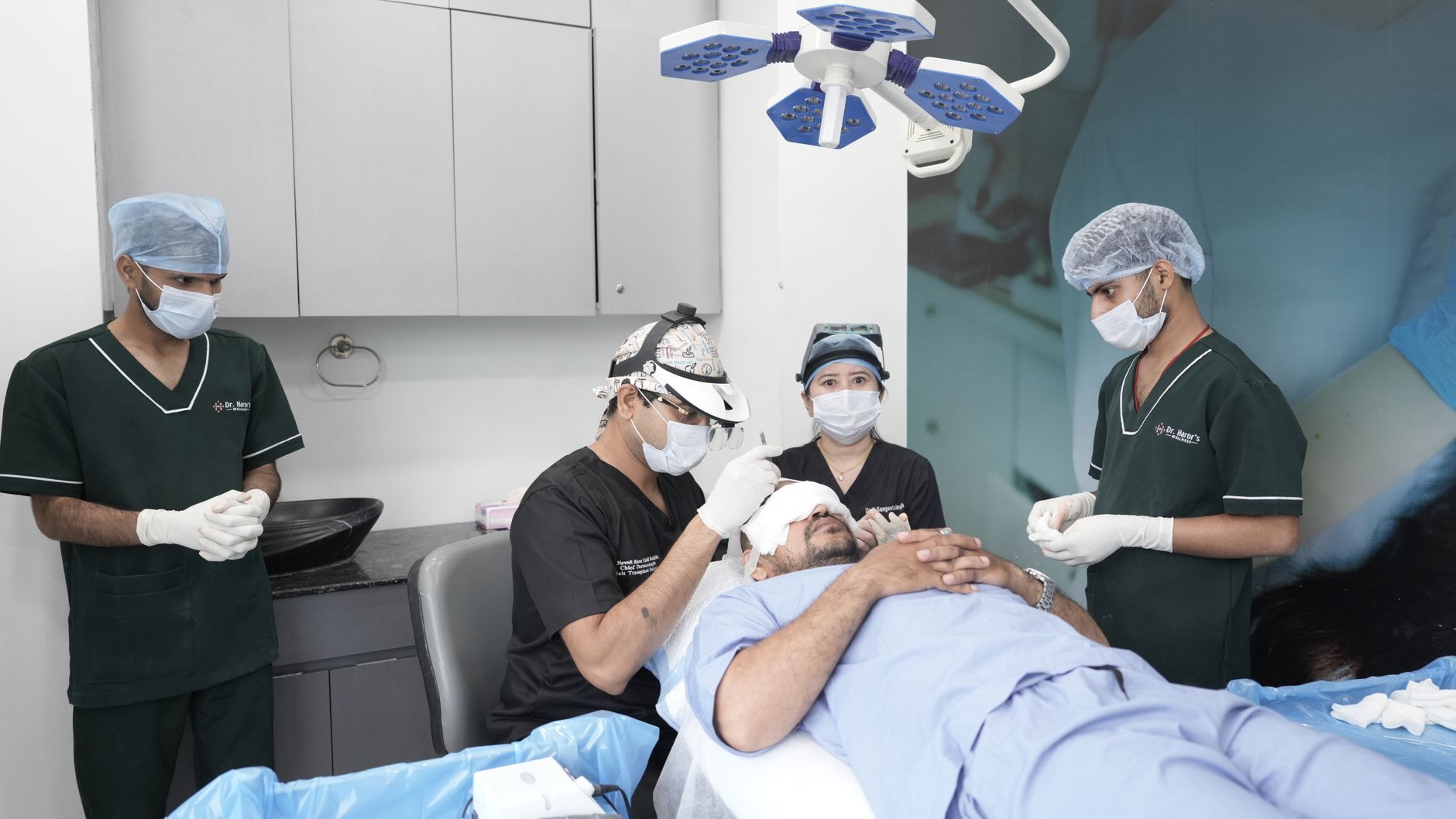
Une greffe de cheveux déplace des follicules pileux de la zone permanente, à l'arrière et sur les côtés du cuir chevelu, vers des zones dégarnies ou devenues chauves. Comme ces follicules donneurs résistent génétiquement à l'hormone responsable de l'alopécie androgénétique, ils continuent de pousser à leur nouvel emplacement. L'intervention convient aux hommes et aux femmes dont la perte est stable et bien définie et dont la zone donneuse est saine — elle n'arrête pas la chute qui se poursuit ailleurs et ne crée pas de cheveux à partir de rien.
Comment se déroule l'intervention
Toute la séance se fait sous anesthésie locale : vous êtes éveillé et, une fois les premières injections passées, vous ressentez de la pression et des mouvements plutôt que de la douleur. Un cas typique demande 6–8 heures, parfois réparties sur la journée. Le chirurgien nettoie et anesthésie d'abord le cuir chevelu, puis les unités folliculaires sont prélevées une à une dans la zone donneuse à l'aide d'un micro-punch de 0,7–1,0 mm. Des sites receveurs sont ouverts selon un angle et une direction précis, et les greffons y sont implantés. C'est l'ordre de ces deux dernières étapes qui distingue les principales techniques.
Planification et dessin de la ligne frontale
Le chirurgien trace avec vous la nouvelle ligne frontale et la zone receveuse, s'accorde sur une estimation du nombre de greffons et photographie les zones donneuse et receveuse.
Prélèvement (extraction)
Les unités folliculaires sont extraites une à une de la zone donneuse au micro-punch et conservées dans une solution réfrigérée qui les protège.
Ouverture des sites
De minuscules incisions sont pratiquées dans la zone dégarnie selon l'angle, la direction et la densité qui reproduisent une pousse naturelle.
Implantation
Les greffons sont placés un à un dans les incisions. Les unités à un seul cheveu vont sur la ligne frontale, celles à plusieurs cheveux derrière, pour la densité.
FUE, FUE saphir et DHI
Presque toutes les greffes modernes sont une forme de FUE (extraction d'unités folliculaires) : les greffons sont prélevés un à un plutôt qu'en découpant une bandelette de cuir chevelu. Les variantes diffèrent surtout par les instruments utilisés pour le site receveur. La FUE saphir ouvre les incisions avec des lames à pointe de saphir plutôt qu'en acier, ce qui permet des incisions plus fines et plus rapprochées. La DHI (Direct Hair Implantation) utilise un implanteur Choi qui ouvre le site et pose le greffon en un seul geste : aucune incision n'est donc préparée à l'avance. Aucune technique n'est supérieure en toutes circonstances ; un bon chirurgien en recommande une en fonction de votre zone donneuse, de la surface traitée et de la densité nécessaire.
| Critère | FUE / FUE saphir | DHI (implanteur Choi) |
|---|---|---|
| Pose des greffons | Incisions ouvertes d'abord, greffons posés ensuite | L'implanteur ouvre et pose en un seul geste |
| Convient surtout à | Grandes surfaces, nombres de greffons élevés, vertex | Détail de la ligne frontale, forte densité, zones réduites |
| Rasage | Le plus souvent rasage complet de la zone receveuse | Souvent possible sans rasage ou en rasage partiel |
| Manipulation des greffons | Les greffons attendent en solution avant la pose | Temps hors du corps plus court par greffon |
| Durée et coût | Plus rapide par séance, généralement moins cher | Plus lent, généralement plus cher |
Le saphir désigne la lame qui ouvre les incisions ; la DHI change la façon dont les greffons sont implantés, pas la façon dont ils sont prélevés.
Greffons, zone donneuse et planification de la couverture
Un greffon n'est pas un seul cheveu : chaque unité folliculaire contient naturellement 1 à 4 cheveux, si bien qu'une séance de 3 000 greffons déplace environ 6 000–7 000 cheveux réels. Votre zone donneuse est une ressource limitée, pour toute la vie — un prélèvement trop agressif dégarnit la zone donneuse elle-même, et c'est irréversible. La planification met en balance trois éléments : votre degré de perte (mesuré sur l'échelle de Norwood), la densité que le chirurgien peut poser sans risque (couramment 40–50 greffons par cm²) et la préservation d'une réserve suffisante pour une éventuelle intervention future. Le dessin de la ligne frontale compte autant que le nombre de greffons : une ligne naturelle est légèrement irrégulière, adaptée à l'âge et inclinée vers l'avant, et non une ligne droite et basse.
Cicatrices et rendu naturel
La FUE laisse de minuscules cicatrices punctiformes réparties sur la zone donneuse, au lieu de la longue ligne unique de l'ancienne méthode par bandelette (FUT). Dès que les cheveux alentour atteignent quelques millimètres, ces points sont généralement invisibles, même si une coupe très courte peut révéler un léger moucheté. Le caractère naturel du résultat dépend moins de la machine que de l'angle, de la direction, de la densité et du dessin de la ligne frontale — c'est précisément là qu'un opérateur expérimenté fait la différence. Des angles mal choisis, une densité excessive ou une ligne trop droite sont la signature d'une intervention bâclée, réalisée uniquement par des techniciens.
Récupération : à quoi ressemble la première année
Jours 1–3
Juste après l'intervention
De petites croûtes se forment autour de chaque greffon ; la zone donneuse est pansée. Un gonflement du front et une gêne légère sont normaux et disparaissent en quelques jours.
Semaines 1–2
Croûtes et premier lavage
Vous suivez un protocole de lavage doux. Les croûtes tombent et la rougeur s'atténue ; vers le 10e jour, les greffons sont fixés.
Semaines 2–4
Chute de choc
Les cheveux greffés tombent. Cela inquiète la plupart des patients, mais le follicule reste vivant sous la peau : seule la tige visible tombe. Cette chute est attendue, ce n'est pas un échec.
Mois 3–4
La repousse commence
De nouveaux cheveux commencent à percer, d'abord fins et clairsemés. À ce stade, la pousse est inégale et s'améliore de mois en mois.
Mois 8
Environ 80 % du résultat
Vers le huitième mois, la majorité des cheveux greffés a poussé et s'épaissit, et la forme du résultat est nette.
Mois 12–18
Le résultat définitif
La densité, la texture et la ligne frontale mûrissent et se stabilisent. Le vertex et les cas traités en DHI peuvent demander les 18 mois complets.
Le prix d'une greffe de cheveux en Turquie
La Turquie est moins chère surtout en raison de frais de structure plus bas, d'un taux de change favorable et d'un volume de patients très élevé, et non de standards chirurgicaux inférieurs : les cliniques de référence travaillent selon les normes internationales. Le prix est habituellement annoncé au greffon ou sous forme de forfait tout compris. Les chiffres ci-dessous sont approximatifs ; votre devis réel n'est établi qu'après une évaluation sérieuse de votre zone donneuse et de votre degré de perte.
| Facteur | Effet sur le prix |
|---|---|
| Nombre de greffons | Le principal levier. Plus de greffons (surface plus large ou perte avancée) coûtent plus cher, que le prix soit au greffon ou au forfait. |
| Technique | La FUE standard sert généralement de base ; la FUE saphir et la DHI coûtent en général plus cher, pour l'instrumentation plus fine et le temps. |
| Implication du chirurgien | Une intervention réalisée ou dirigée par le chirurgien coûte plus cher qu'une intervention menée par des techniciens — et cela mérite d'être vérifié. |
| Ce qui est inclus | Les forfaits tout compris intègrent souvent hôtel, transferts, médicaments et suivi ; les devis détaillés paraissent moins chers mais s'additionnent. |
Les prix sont approximatifs et ne sont confirmés qu'après une évaluation individuelle.
1 500–3 000 €
forfait tout compris typique en Turquie
1 500–4 000+
greffons lors d'une séance typique
12–18 mois
avant que le résultat définitif ne soit stabilisé
Choisir en sécurité : chirurgien ou technicien
La plus grande question de qualité est qui réalise réellement votre intervention. Faites-vous remettre par écrit l'estimation du nombre de greffons, la technique et le nom de l'opérateur, demandez quelles étapes le médecin effectue personnellement, et méfiez-vous d'un nombre de greffons ferme annoncé avant que quiconque ait examiné votre cuir chevelu en détail. Considérez « 5 000 greffons en une journée » à prix cassé comme une alerte, pas comme une bonne affaire : les méga-séances épuisent la zone donneuse et les comptages sont souvent gonflés. Comparez au moins trois cliniques sur les mêmes points précis, y compris le suivi et la politique de retouche si la pousse déçoit.
Qui tient le punch ?
Dans de nombreuses cliniques à fort volume, le chirurgien trace la ligne frontale puis s'en va, tandis que des techniciens non habilités assurent l'extraction et l'implantation le reste de la journée. Faites confirmer par écrit quelles étapes un médecin diplômé réalise personnellement. Un chirurgien nommément identifié et vérifiable, qui reste dans la salle, vaut plus que n'importe quelle remise sur le forfait.
Information générale, pas un avis médical
Cette page fournit une information générale et ne remplace pas une consultation médicale. Savoir si une greffe de cheveux vous convient, quelle technique est adaptée et combien de greffons sont réalistes ne peut être décidé qu'après une évaluation individuelle par un médecin qualifié. Chaque fiche WhichClinic est vérifiée, mais la décision clinique vous appartient toujours, à vous et à votre chirurgien.
Une greffe de cheveux est définitive — les bonnes comme les mauvaises. L'heure passée à vérifier qui tiendra le punch compte davantage que l'année passée à attendre la pousse.
— Équipe médicale de WhichClinic
Recevez des devis gratuits pour Greffe de cheveux en Turquie
Dites-nous ce dont vous avez besoin et recevez des offres personnalisées de cliniques vérifiées — gratuit, confidentiel et sans engagement.
- Uniquement des cliniques vérifiées et accréditées
- Gratuit et sans engagement
- Comparez plusieurs offres côte à côte
Vos données restent confidentielles — partagées uniquement avec les cliniques correspondantes.